
Replacing a cracked or sunken driveway
When an old concrete or asphalt driveway has heaved or broken up, we tear it out, find out why it failed and build the new paver driveway on a base made for the load.
Old driveway sinking, cracking or shifting at the edges? We build paver driveways on a solid base with firm edges so they stay put.
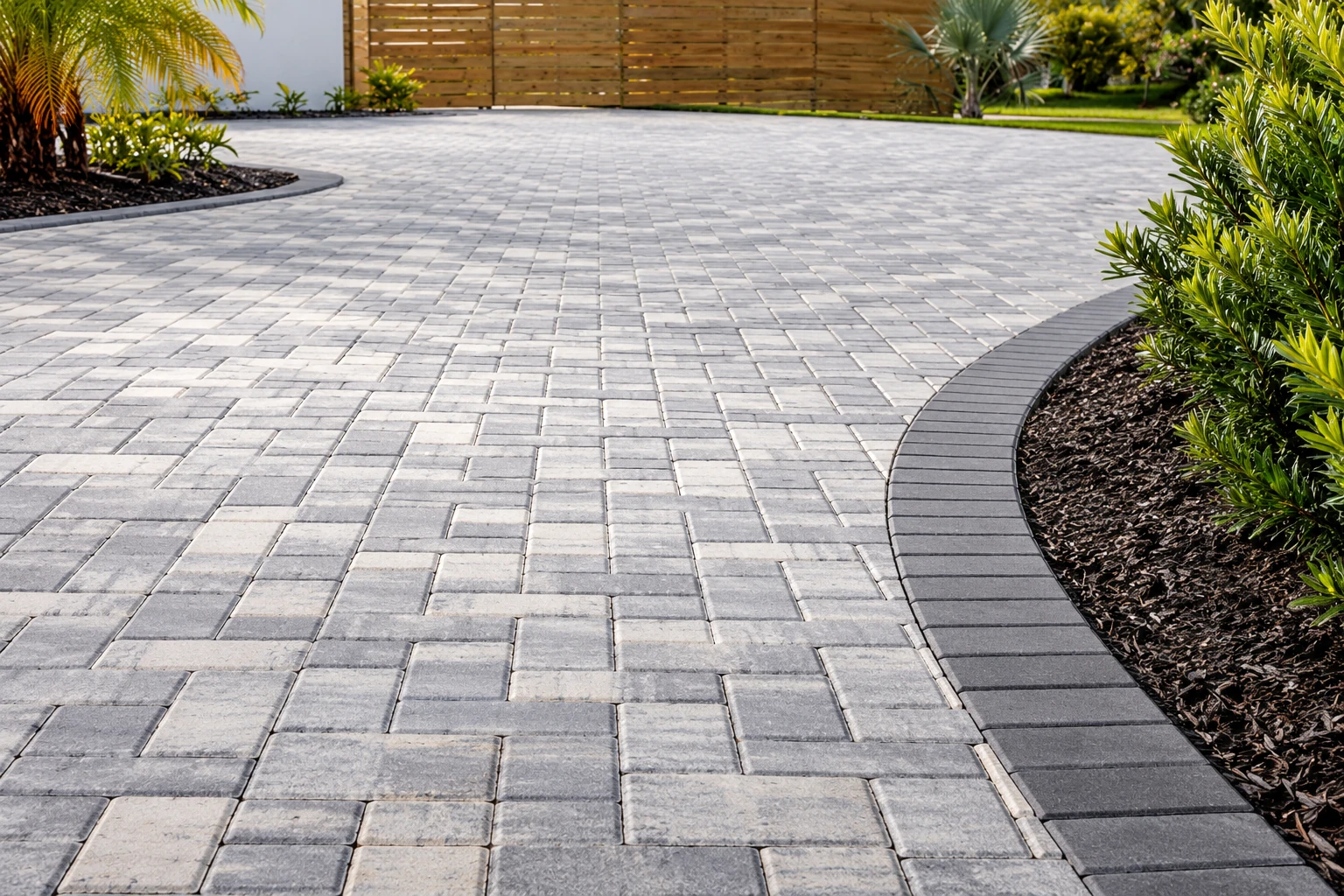
Driveway pavers in Loveland are interlocking concrete pavers laid on a sand bed over a compacted base, and when that base and the edges are built right, the pavers stay locked together and carry your car without sinking.
Most calls start with a driveway that's sinking, cracking or spreading at the edges, and most of the time the trouble is underneath, in a base that was too thin or edging that let go. The price mostly comes down to how big the driveway is, whether an old one has to come out first, how deep a base it needs, what edging and pattern go in, and whether you pick concrete pavers or brick.
The schedule mostly turns on the weather, since the base has to go in on ground that isn't frozen, and on whether the work reaches the street, where the city's permit review adds time. For your own figure, I'll come out to your house and write you an estimate.
If your old driveway sank or cracked, I want to know why before we build, because laying new pavers over the same soft spot or drainage problem just lets you down again.
I'm the one who looks at your driveway and writes the estimate, and I work on site alongside our masons, so the person who priced the job is there while it's built.
If your driveway only needs a few sunken pavers lifted and reset, not a full rebuild, I'll tell you so, because there's no sense paying for more than the problem calls for.
We start by digging out the old driveway or the soil, deep enough to make room for a real base, because the base is what carries your car and the pavers only ride on top. Our crew spreads the gravel in layers and packs each one hard before the next goes on, then lays a thin sand bed to set the pavers in. When pavers sink or rut, it's nearly always the base that gave out, so that's where we spend our effort.
Solid edging goes in along every side so the pavers stay put. Where you park and turn the wheel, we lay herringbone, a zigzag where each paver braces against the ones around it, so the surface stays locked together under tires. If your driveway runs along a slope, we can add retaining wall construction to hold the ground beside it, and if the brick steps or columns nearby are worn, our masonry restoration work can bring them back while we're there.
Where your driveway meets the street, the City of Loveland has a say, because that strip is public right-of-way. The city can take up to ten business days to approve a right-of-way permit, not counting the day it's submitted, and longer if the work needs a lot of traffic control or a lane or street closed. Under that permit, a call has to go in 48 hours before work starts to schedule an inspection, and when a permit is needed, we handle the application and set up the inspections. If your street is part of US 287, US 34, SH 402 or SH 60, the city also needs a copy of a permit from the Colorado Department of Transportation.
When an old concrete or asphalt driveway has heaved or broken up, we tear it out, find out why it failed and build the new paver driveway on a base made for the load.
A paver pad or a wider lane beside your driveway gives you space for another car, and we tie the new pavers into the layout so the edges stay tight where they meet.
If you like the look of a brick driveway, we lay brick pavers on the same compacted base and edging, and we'll help you pick a brick that suits the house.
Plenty of homeowners want the path to the front door in the same pavers or brick as the driveway, so we plan both together and keep the color and pattern consistent.
Send us the form and we'll get back to you within one business day to set a time for me to come out. The estimate is free, done at your property, and comes with no obligation.
We write down what the price covers, from tear-out to base, edging and pavers, so you can see it all in one place and compare it fairly with other quotes.
Note the driveway's rough size in square feet, whether an old driveway has to come out and whether the work reaches the street, because each one changes the price or the paperwork.
We're licensed and fully insured, and every paver driveway we build carries the same promise as the rest of our work. Satisfaction guaranteed on every job.
Use these photos to think about paver colors, brick borders and herringbone or straight-run layouts we can talk through when I come out.
These are the questions homeowners usually ask while they're comparing paver driveway quotes, with plain answers you can use.
A sand-based concrete paver or brick driveway in Loveland usually costs about $15 to $20 per square foot, and that doesn't include tearing out an old driveway. Base depth, edging, the pattern and, with brick, the quality of the brick you pick all move the total. Our free estimate puts the figure for your driveway in writing.
Industry guidance calls for at least 6 inches of compacted base under a home driveway on well-drained soil, and 2 to 4 inches more in cold climates where the ground stays wet or weak. Typical Loveland price figures assume a 4-inch base, so ask every contractor what depth their quote includes before you compare numbers.
Herringbone is the pattern recommended wherever cars drive every day, because it gives the most interlock and strength of any layout. If you're weighing a few looks, ask for herringbone at least where the car parks and turns, and you can still use a border or a different pattern in spots that don't take traffic.
A paver driveway needs a solid edge restraint on every side, because that's what holds the pavers and sand together so they stay interlocked. Steel, aluminum, a concrete curb or plastic edging made for concrete pavers can all be used on a driveway, so ask which one a quote includes before you compare prices.
Only when the ground isn't frozen, because industry guidance says base material should go in unfrozen and not over frozen soil. That's why we plan the start around the weather. Once it's in, snow comes off pavers the same way it comes off any other pavement, and concrete pavers can resist deicing salt better than conventional paving.
The city issues right-of-way permits for work in the public strip along the street, a Major permit for any right-of-way work no matter how large or small, and a Minor permit for concrete driveway approaches and sidewalks. Which one fits depends on what part of your job reaches that strip, so I'll sort that out when I see where your driveway meets the street.
Call (970) 292-7476 any day from 7 AM to 11 PM or send the form, and I'll come see your driveway in Loveland or nearby.